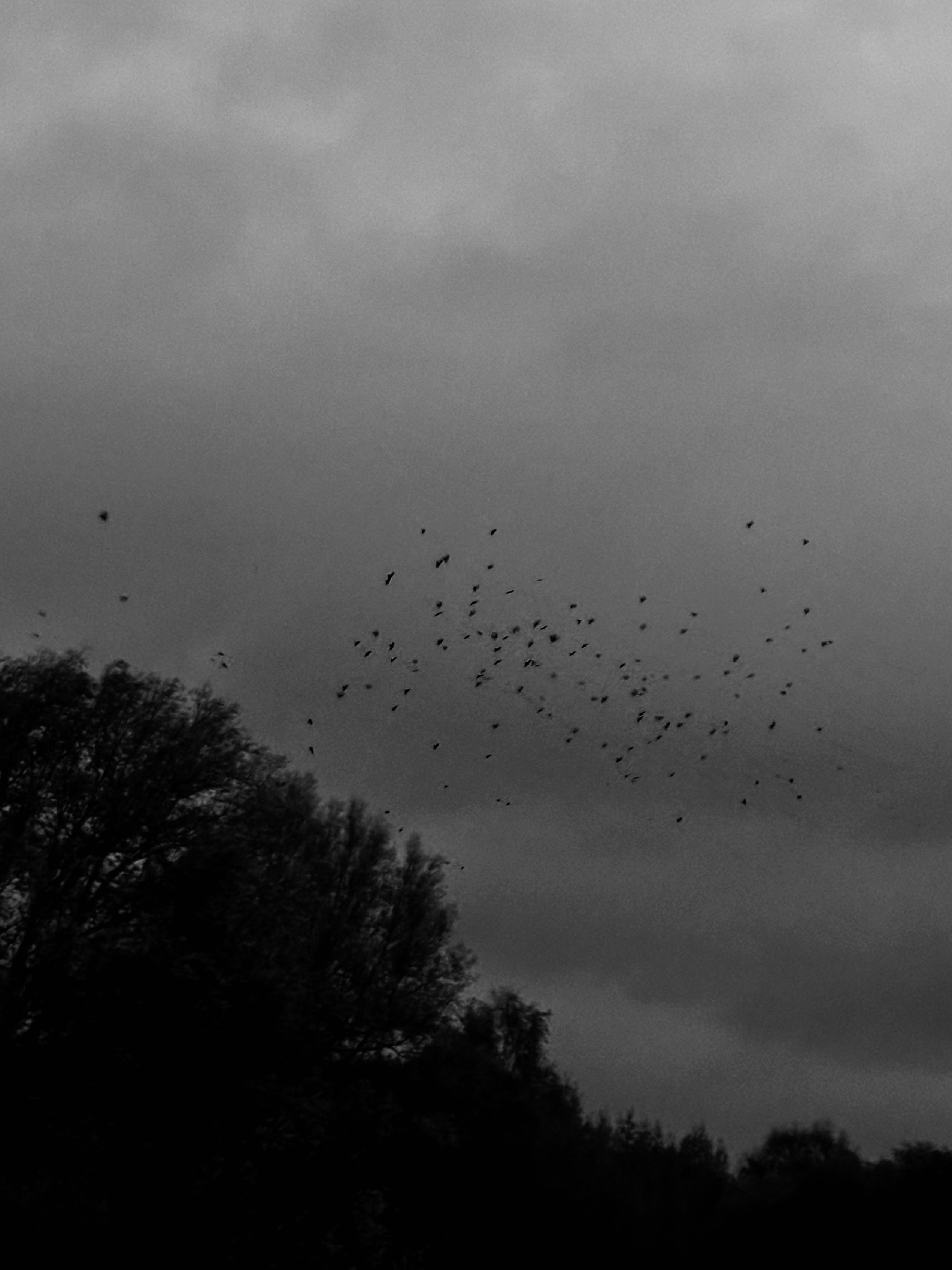
Meeting ghosts and goldcrests on edge of the marshes.

Remembrance Sunday only became a thing in 1946, taking place on 10th November of that year, 434 days after the end of the Second World War. Prior to this, the national period of collective mourning had been on Armistice Day, which, as we can all recite, was to be at the eleventh hour of the eleventh day of the eleventh month, to mark the occasion when the Great War ceased in 1918, according to the agreement reached between the allies and central powers in the early hours of that same morning. This time is still observed – services are held, and two minute’s silence maintained across radio stations and television channels – but Remembrance Sunday, or just ‘remembrance day’ or ‘poppy day’, has grown to be the larger and more significant event, with the ceremony at the Cenotaph an occasion of state, honouring those lost in all conflicts.
At the time of writing, there are still a handful of people who were alive during the First World War, including Britain’s most senior citizen, and currently the oldest person in the world, the remarkable Ethel Caterham, born in 1909 – before even the South Pole was attained, let alone the Moon – would have been nine years old when the Armistice was signed, and almost ten when the Treaty of Versailles finally brought the whole thing to an end. Despite the longevity of Ethel and the rest of the supercentenarians, we are becoming untethered from that time, the centenary of the end of the First World War in 2018 perhaps also marked our final great act of collective memorial. Time marches on. The silence marking Armistice Day has already started to feel like an anachronism, a strange relic drifting toward the same relevance as Trafalgar Day, or one of those peculiar and ancient rituals which has lost much of its meaning yet still gets an annual airing, the obby oss, the straw bear, cheese rolling, well dressing.
Between a stint at art school and reluctantly joining the real world, I worked, briefly, at a record shop in Southend-on-Sea. Through the shop window you could see people milling around what passes for a town square. From the till – in between selling Peter Andre posters and Franz Ferdinand CDs – it was possible to glimpse the outside world, and after a few weeks of working there the daily rhythm of life on the other side of the glass became familiar, first the suits and commuters, then shoppers on their way to Woolworths or Primark, then council workers on lunch, mums with buggies, school children, newspaper sellers, then suits and commuters again, as shadows moved around concrete arches. Other more transitory lifeforms also came and went, the clack of skateboards, the time-killing drifters, the alcoholics, the homeless, the dealers, hiding in plain sight by the benches, making swift exchanges of notes for a bag, they tended to float in and out of the day, but were always in place before sunrise when we lifted the shutters for the early shift, and were still there under the amber lights when we locked up at night, never seen to leave or arrive, like the gulls on the roof of the chip shop.
One grey, soulless morning the duty manager informed us before opening the doors that ‘Remember it’s the 11th of November today, so you need to be silent for a minute at 11 o’clock. If anyone talks to you, don’t talk back.’ This unusual but unequivocal statement was presented in a matter-of-fact way, as if it related to something workaday, like a delivery time being changed. As I was a kid I didn’t speak up or question it but let it play on my mind. I took it quite seriously. I thought about it all morning, fretting about what would happen if anyone tried to talk to me at 11 o’clock. It was mid-week, pretty quiet, so I reasoned it shouldn’t be too bad. At two minutes to eleven, the world was working as normal, feral pigeons landing, W.H. Smith bags billowing, bin lorries reversing, boys bunking school shouting at nothing in particular. Maybe nothing would happen, nothing much ever really did happen after all.
Then, with an alarming, almost military precision, everything stopped. As if there has been some pre-agreed secret sign, or a signal beamed from an alien craft, people stopped moving, and stood, stock-still, heads bowed or looking up. Like the coiled spring of a clockwork toy finally running slack, the mechanism stopped. The music inside the shop ceased abruptly. The person I had just sold a Record Collector magazine to had frozen, halfway to the door, checking his watch and was now fixed, staring down at a rack of new vinyl. The kid on the same shift as me, Lee I think his name was, was looking at his shoes, as was the manager up by the security door, but with one hand holding down the volume button on the instore stereo. The two customers I could see in the shop were like statues, hands by their sides, one still awkwardly holding an LP.
The next customer in the queue, a man maybe in his late thirties, clean looking, spring heeled and with some disposable income, was so focused on making his purchase to be completely unaware of what was going on, took a couple of steps forward and put his items down on the counter. I gawped at him, this only moving part in a silent, static world.
‘I’ve been looking for something like this for ages.’ He said, out loud – out loud – pointing down at the rolled-up, vintage style Star Wars poster he was about to buy. ‘I guess it came out when they reissued the original trilogy on DVD?’
I looked around for help, for any guidance as to what to do in this situation. There was no eye to meet. To my left and just in front of our window, was a woman, maybe in her seventies or eighties, hunched in a beige mac, leaning on a wheeled shopper. Brown Sycamore leaves skittled past the door. Two middle-aged men, both with glasses and suit jackets, were a little way from her, everyone beyond them was reduced to blurred outlines, moving as much as the life-sized cardboard cut-out figures of Britney, Buffy, and Bruce Lee which populated our window display. The man unloading the deliveries on the opposite side of the square had stopped halfway between his cab and the back of the lorry, his head down and with his hands clasped in front of him. Lee, and the manager, were still similarly unmoved. The customer was trying to catch my eye.
‘That’s for my daughter.’ He said, feigning embarrassment, referring to a Rugrats keyring and badge set on the counter.
I finally looked up and met his gaze. But kept my lips pursed. His smile faltered.
Feeling like a condemned man I painstakingly rang through the stuff on the counter, until the total pinged up on the till display. There then followed a tense, awkward silence, which replaced the part where you would normally say, ‘…that’s 8.99 please’ and which seemed to go on for about three hours. Instead, I eyeballed him with what was probably quite an intense stare and just nodded at the till. Maybe the guy was freaking out a bit now, but in hindsight he probably just thought I was undergoing some sort of mental breakdown. With a slightly open mouth he handed over a folded tenner and, with as much respect for the fallen as I could muster, I clicked the till open for the change. In the blank void of the minute’s silence this transaction sounded like a peal of church bells. I reached down and placed his stuff in a plastic bag and handed it to him without saying a word.
‘Oh great, okay, thanks for that. Bye then.’ he said, frowning at me, and glancing over his shoulder as he walked off, brushing past the other customer still bowed by the vinyl racks, before cracking open the door, walking past the elderly lady at the storefront, and disappearing out into the world. I felt like I had been part of a great transgression, cursed to forever bear a mark of shame. In a moment, the music restarted, people walked on, and nothing was ever spoken of it.
And so now, many hundreds of millions of years later I find myself standing alone, in a field by an oakwood at two minutes to eleven, on the eleventh day of the eleventh month. That moment at the till, which now feels sepia-toned, migrates into my consciousness every Armistice Day, it is seared into a memory file somewhere deep down, although it becomes more comical, and distorted with time. Leaning on the broken stile I checked my watch and gazed across the empty fields. It’s odd how frequently that, in the most populous part of one of the most densely populated countries in Europe, there is near total emptiness. Fields and woods devoid of people, no livestock, no cars, houses, aeroplanes, noise or movement of any kind. This seems to happen regularly, so much so that it is slightly unsettling. We are so used to being surrounded by people, things, and stuff, all the time that, when brought suddenly face to face with what is essentially a lost point of view, a window into the same sparsely populated, silent countryside a late medieval farm worker would’ve known, where the failing light signalled the end of the day, it is a jolt and a jar to the system, like waking and finding yourself trapped in a film about the collapse of civilisation.
From the stile the horizon was about a mile or so away, at a guess, from one side of the gently sloping valley to the other, and a bit longer in the other direction, before the land and trees blotted the edges. The only movement was the breeze blowing drizzle, and shuffling dying leaves. I had seen nothing and no-one since getting out of the car two hours previously, the last person was a man getting into a car outside his house near to where I parked, giving me the look, the who-the-hell-are-you eyes, which happens a lot, and is entirely understandable, it being directed at a natural object of suspicion, a lone walker, without a dog, or a bike, or a drone, in some backwoods hamlet, in the arse-end of nowhere, outside term time, mid-morning, mid-week, in the rain. But, since then, it had just been a footpath devoid of life, except the birds that I was surveying.
I had taken a circuitous route to avoid a flooded field, but which took me away from the survey area, to weave into a small woodland, following the public footpath. The wood was dense, unmanaged, and, by the state of the path probably not that well used. There was little in the way of birdsong, except a salvo from a group of Corvids, and, for a brief time at the entrance to the wood, the sharp, wintry ping of the little prince, the Goldcrest Regulus regulus, in a small flock, and possibly new arrivals to these shores. The Goldcrest, Europe’s’ smallest bird, crowned by a bright yellow plume, is a resident species in the UK with numbers swelled in the winter by migrants from the continent. As with other diminutive wintering species, such as the Robin Erithacus rubecula and Wren Troglodytes troglodytes, there is a good deal of folklore attached to the Goldcrest. For a long time, it was considered too weak and small to fly very far, and certainly not across oceans, which left its increase in number over winter something of mystery. Instead of flying, which they do perfectly comfortably, they were thought to hitch a ride across the sea on the backs of other, larger birds, particularly the Woodcock Scolopax rusticola, which arrives at more or less the same time in the autumn, and in similar habitats, giving the Goldcrest one of its common names of Woodcock Pilot. There are a few Europe-wide fables linked to its supposed cleverness and guile, in the most famous story, the Goldcrest enters a competition to see which bird could fly the highest, with the winner crowned king of birds, although it was roundly mocked for entering. The eagle was naturally the favourite, but just before the eagle’s attempt, the cunning Goldcrest quietly stowed itself away under the eagle’s wing, and when the exhausted eagle could fly no higher, the Goldcrest emerged and climbed a few more feet to take the golden crown, which still sits on its head today…
Stepping through the wood across a grey-brown stream running at full, bubbling spate I followed the path until it ran into a clearing with a patch of scrub and an old stack of cordwood, mouldering and mossy. The path seemed to continue around the side but then narrowed and petered out into a random broken fence and a maze of birches and chestnut. I’d had my head down, and idly followed the path without really looking up or checking my surroundings, and now, picking a way back through the tangled web of briars, and ducking under fallen trees, I noticed the quiet in this lonely wood, a deep silence, and that familiar feeling of being watched crept into my thoughts. There was a crumbling timber-framed building just to the north of the path, somewhere between a log store and woodsman’s cabin, with a moss-covered roof and half hidden by trees. Two windows, one glazed one black and hollow. It made the hairs stand up on my neck, down in the uncanny valley. I didn’t bother looking for the path but made my way out as best I could, moving through the wood as quickly as I could muster, roughly following a direction in my head, looking for the lighter patches in the sky through the canopy.
I breathed a sigh of relief at the boundary fence, waist high but covered in barbed wire, wound round thickly and impassable, stopping me dead. But on the other side was the open country, daylight, the smell of wind-blown rain and rushes, a field of cropped grass with a small flock of glum, damp sheep. Following the fence along the boundary and, after a ten-minute scramble, I found the stile, slick with algae and half broken, but at least leading into the field and out of the woods. Looking back into the woodland, the end of the path I had lost stopped after a few metres, halted by a fallen oak. The old stile was a natural rest stop.
It took a while to realise what I was hearing, but like being woken from a dream the snapping whizz bang of an unlikely bird filtered through. Amongst the dead leaves, somewhere in the branches high at the crown, was the scarlet coat and excitable zip of theCommonCrossbill Loxia curvirostra. Another resident, semi-migrant but well out of its comfort zone here between sheep fields, cropland and on the edge of an old oakwood and chestnut plantation. They are mostly at home in pine forests, where they use their startling ogee curved beak to slip open pinecones and crack husks for the seeds inside, and are a species generally of upland Britain but they can also be found here in the lowlands, particularly the New Forest, the Surrey Hills and dotted across the Weald. More so than the Goldcrest, their winter movements, compounded with the arrival of numbers from the continent can make it problematic to assess populations or trends, but the current research show they are at least stable, if not increasing, a bit of an outlier then, from an avifaunal perspective. It took a long time to leave the spot – it’s not often you chance upon a gem – and in honesty I think eventually they left me, disappearing off into the deep wood, away from the edge.
The footpath swung round and back into the survey area. Greeting the sheep by name I crossed the small field, avoiding the poached ground, and climbed over the next stile, a much sturdier affair with some recent repairs. On the other side, nailed to a fence post was a simple cross, bearing a small brass plaque, neatly engraved, commemorating an RAF pilot who had died during the Second World War. I read the short inscription several times, and wondered why it was there, of all places, in a corner of a quiet field, on the edge of a wood, many miles from a town or village, or airfield. Perhaps it indicated a crash site, or a local boy. The memorial cross, with its stylised poppy did serve another purpose of memory – it was almost eleven o’clock.
The path back dropped down into boggy fields of rush pasture cut with dykes and natural stream beds, marking what would once have been the coast or the edge of the tidal range, before the drainage of the marshes and the pushing back of the sea. There was a strong gust of wind, and the sky, in the words of Uncle Monty, was beginning to bruise, the cloud thickening, darkening, drizzle turning to rain. From a reed-clustered swollen stream two Snipe rocketed along the channel, letting off their scraping alarm call of an engine backfiring or the rasp of gun shots, briefly coming up for air, then banking back down further along the stream. At the foot of the valley these streams met in a confluence, the recent wet weather swelling the watercourses and flooding the land until there was no other place for it to go but here, pooling in a field of slick clay and drowning winter wheat, the ranks of bright green seedlings thinning to stunted, pale weaklings in the bog, then nothing. In six months, this would be a bowl of cracked brown earth in the corner of the corn field, with a few pioneer Willowherbs, and kicking up dust whenever the wind blew. I stalked around the edge of the morass, boots sucked down into the mud, as if a hand pulled on each foot. The other side of the valley was equally hard going, and off the path the hill was a slippery mass of tilled wet earth. Stopping for a breather I looked back down the slope to the network of streams. A Grey Heron Ardea cinerea was watching from the edge of a dyke, partly hidden by reeds and brambles, not moving a muscle or flicking a feather, its sharp yellow eye fixed on me for any sign of danger. I realised I must’ve crossed the stream not far from the Heron, close enough to cause the bird to flush from the bank, but in the cold, snapping drizzle I think it had gambled that I might not pose a threat, and that maintaining this good fishing spot, on a clear, deep bend, and sheltered against the weather, was worth the risk, particularly if it led to catching a meal sooner rather than later. Against a rogue Chestnut tree, I watched the grey sentinel dip its head back down to the water and continue its vigil.
