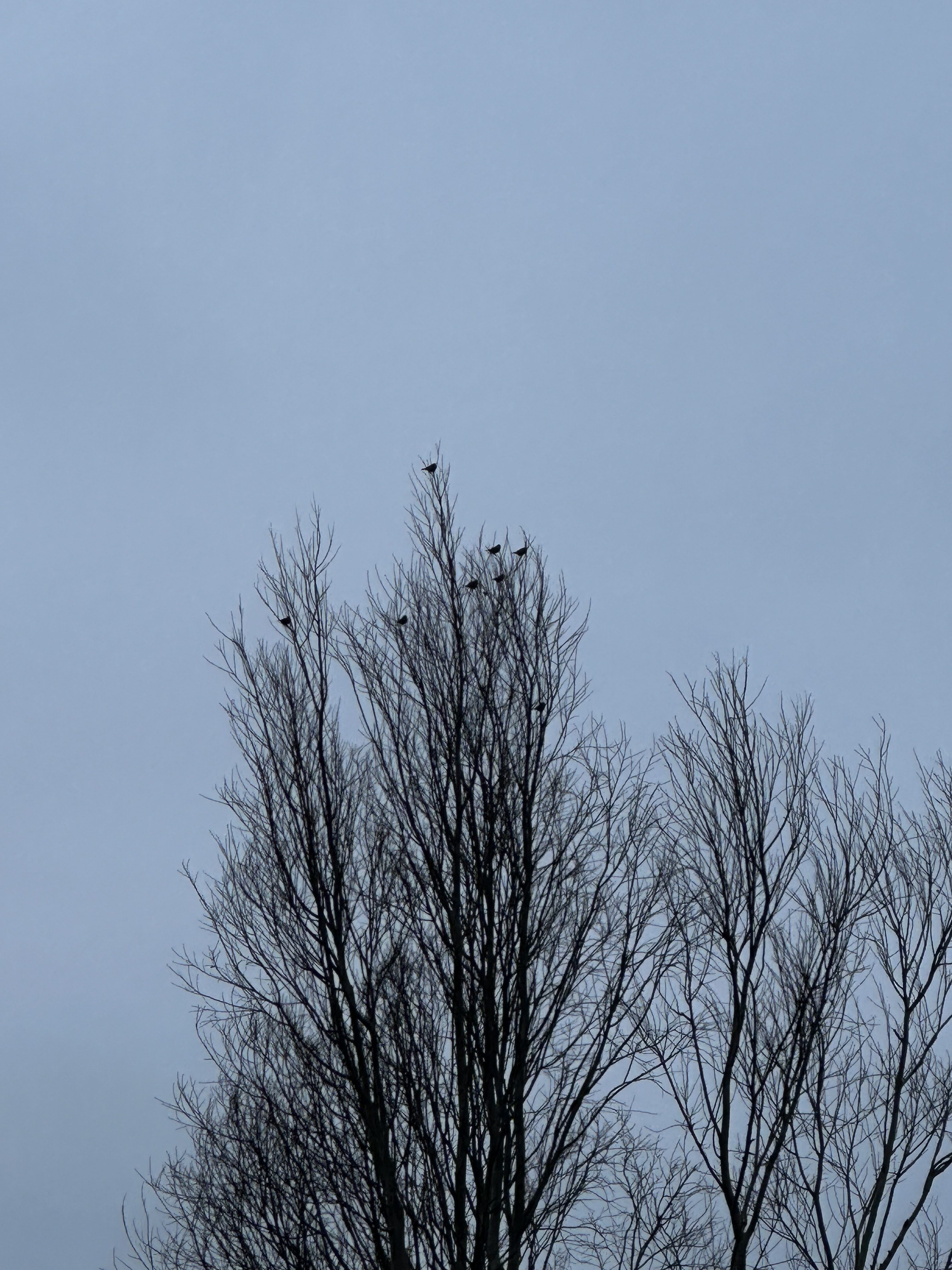

A damp and cold day, with frost hiding in the shadows until the afternoon, mist sticking to treetops. December, as pointed out to me once, is not really a winter month, but the back end of autumn. Winter, in its full glory arrives in the south of England in January, when the seas have cooled and the land no longer insulated by the relatively warm water. This certainly feels true of the beginning of December when, in some places at least, leaves flicker on trees, solitary bees visit ivy flowers, and grassland slopes still have that sheen of late summer, even after the first frost. But by the middle of the month, with Christmas wobbling down the calendar, the winter starts its creep. Maybe it’s the bombardment of images at this time, showing snow clad high streets, flurries across rooftops, lorries blasting through blizzards and the like, that have undue influence, despite no discernible change in the weather. It’s mainly the light, or rather the lack of it, that is the real signifier of the turn of the season. As the shortest day approaches, sunlight is drained from the land and, by the middle of the month, the night stretches over 16 hours of darkness in the south. On a day of heavy cloud, of which there are many, the dawn is slow to catch up with the sunrise, reduced to a baleful murk behind the haze, and a few gloomy hours around noon constitutes much of our daylight at the end of the year. Some creatures and plants are attuned to light more than temperature, and their winter starts as the light fades, not when the temperatures drop.
There is a scrap of woodland, a short walk down the road, past the house with the two dogs that bark and the broken fence panel, just a triangle of mixed trees squeezed between expansive oakwoods and the small, enclosed grazing paddocks, farms and gardens. The triangle shaped woodland is on a slight slope and if it wasn’t for this gradient, it would be possible to see from one side to the other, the trees being spaced well apart, dotted with tall Scots Pine and an understory dominated by shoulder high Bracken. On the edges and verges, there are patches of Red and Sheep’s Fescue, Ling, Gorse, and Devil’s-bit Scabious, a thin skein of acidic soils, the very last fling of the Ashdown Forest before it melts into the green hummocks of farmland.
A nervous chatter at the entrance of wood, in the canopy of a group of Aspen, a burst of leaf shaking and clacking – the familiar-yet-not calls of a group of RedwingTurdus iliacus, moving through the woods, following a foraging trail into the fields. In the autumn, after the summer visitors have left, there seems to be a dearth of colour and life in countryside, the hedgerows shorn of warblers and songbirds, the swallows and martins swept from the skies. This gap is soon filled with the arrival of the winter thrushes, birds moving from Scandinavia, Siberia, and the Arctic, south to Europe and beyond. This includes species familiar to us – Blackbirds, Song and Mistle Thrushes – and also the more unusual varieties, Redwing and Fieldfare Turdus pilaris, their flashes of colour and alien calls bringing a much-needed burst of exoticism to the land. Like all thrushes they are mainly fruit-eating over winter, and seek out food resources with unerring accuracy, descending on unsuspecting hedgerows, windbreak planting, and outgrown coverts to strip them of their berries, sloes, haws, hips, damsons, mummified blackberries, half-shrivelled crab-apples, pears, plums, pips and all. Like many species they are equally happy taking whatever else they can find at this time of year and will feast on whatever resource is at hand. But it is the hedgerows – if they have avoided being gutted by the tractor flail – that provide the most bounty, as they traditionally contain the heavily fruiting species, mainly Hawthorn, Dogwoods, Buckthorns, Blackthorn, a Rose or two. Rowan is also favoured by the thrushes, as are those frequently damned alien species, the Pyracantha and Cotoneaster. Although they tend to shy away from urban areas they will venture into orchards, parks and even gardens when food is scarce, and like those other strange and wonderful winter visitors, Hawfinch and Waxwing, they can sometimes be found en masse, attacking the planting of new builds, screeching around supermarket car parks, and bothering the municipal roadside trees.
Aside from a handful of adventurous pairs, these winter thrushes breed outside these islands, far to the north, on the edge of the Arctic. A recent encounter with them during their breeding season caught me unawares. As I was walking up the gently sloping backstreet of Suðurgata in downtown Reykjavik last summer, past the Hólavallagarður cemetery. Alongside the headstones the cemetery is home to a tangled web of mature trees. Since the early part of the twentieth century when first whips were planted by locals, in and over the graves, the cemetery has developed into a small forest, and forests, however small, are a rare treat in Iceland, be it in the city or country. These trees, including many Rowan, are now a vital wedge of habitat in the capital, providing shelter, food and a home for a mosaic of lifeforms. The clattering and whistling started almost as I got alongside the cemetery, a strange group of birds making alien noises. The Redwings were at eye level, a few feet away, on branches and on the top of gravestones, hopping, harried and in a hurry. I stopped to watch for a moment, quickly overtaken by a tutting local pushing a pram, making side-eyes at the rube suddenly blocking the narrow pavement. But there they were, smart, coffee-cream eyestripe and glorious flash of crimson on the flank, and the keen, yellow eye of the thrush. Usually these are fleeting glimpses, on a see-your-breath winter’s day as they move from orchard hedge to farm gate, but here, in the city heat of a 16oC summer’s day in Iceland they were at ease, chatty, laid back, not keen on disappearing, as mad and outrageous as Toucans and Hornbills pecking amongst the pigeons in Trafalgar Square.
The footpath skirts the edge of the triangle of woodland. It’s occasionally used by dog walkers, a few cyclists and the odd runner. But generally, it is a quiet, almost non-descript wood, well off the worn tracks of the Ashdown Forest. Halfway along the path something caught my eye. A flash of red on a trunk of a Downy Birch. A red rectangle in fact, and not a natural form, something made by lichen or algae, but badly scribbled in red felt pen. In the centre, the sad and unmistakable broken cross of the Swastika. Around the old, grim flag of the Nazi party were a series of other scratchings in blue biro, Hail Mosley, Hail Hitler, Oswald M, Seig Heil, ground into the bark with some determination. There were two or three hands at work. Adult, or young adult, or child, covering the face of the Downy Birch at around chest height. They got lucky here. Downy Birch, by their nature, do not provide much in the way of flat surfaces. Probably the most common birch on the Forest, they tend to be rougher barked than their silver cousins, with more splits, knots, and caruncles, and trunks often mottled with a rusty alga or discoloured with wet extrusions and weeping fissures. But this specimen, in late middle age, had a fine trunk with a broad section of unsplit, unruffled white-gold bark, presenting to some a perfect surface, like the page of a book, a car window, or toilet cubicle door. Woody Guthrie once painted ‘This Machine Kills Fascists’ on the side of his guitar, the words distinct and unmistakable against the flat, polished wood of the soundbox, although not cut from Downy Birch, but maybe an oak, spruce or mahogany.
In the built world, away from nature, in the world of billboards, bus stops, screens, traffic and tarmac, extremist symbols, language, and imagery are commonplace, whether scrawled, painted, government approved, expensive advertising, or flapping flags, menace and thuggery are inherent in that world and perhaps always have been in some capacity. But away from this, in nature, it is not the case, or at least less so. Here, there is threat but is in accordance with the laws of nature, a poisonous plant, venomous snake, or hungry tick, of course all carry more real and present danger than a drawing, yet the appearance of a scratched image of a flag here in the wood carries more implied menace than any reptile or insect. The human world, the online world, has bled into the wild.
I went through a brief graffiti phase, somewhere between the beginning and end of school. In the dark, empty high street, on a bus stop outside the shoe shop I scribbled my rubbish tag a few times in marker pen, and then, stuck for something to say, wrote “Punks not dead” [sic] in marker pen and a little further along, “Acid House” and a smiley face 🙂 I only had the sketchiest idea of what Punk was, let alone whether it was alive or not. I knew precisely zero about Acid House. But I had seen both slogans carefully painted in tippex on the army surplus satchel of an older kid at school. They must mean something. A friend at school would frequently graffiti short slogans on any surface he could find, mainly a series of letters and symbols comprising C18, NF, and HH on all manner of things, desks, railings, schoolbooks, toilet cubicles, and anything else with a semi-flat surface. The meaning behind these messages would be obscure if it wasn’t also for the frequent appearance of a swastika providing a suggestion of significance. His obscene fascination with the far right was born at home, from his dad, an avowed white supremacist who held a disturbingly high position in civil society. We viewed him and his dad not as dangerous thugs, but as outsiders, cranks, more like Keith Pratt and Candice-Marie than anything else, and at that point, a lifetime ago, it would have been difficult to imagine the current normalisation and platforming of the far right in Britain, as their defeat in the Second World War is close to a founding myth for post-war, post-colonial Britain.
A north-easterly breeze whipped the tops of the trees, causing the pines to brush like yard brooms and the lone Aspen to flutter nervously. If it wasn’t for the widespread acceptance of the far right, I would chalk up Nazi sloganeering in the woodland to the youthful idiocy of the Punks Not Dead category, or a lone-wolf weirdo with a fanatic father. And still, it may be. But it seems unlikely.
At the other side of the wood, the view opened out again, a sheep field with frost clinging to the base of the hedgerow. The Redwings, gathered together in their flock once more, had crossed from the cover of the woods to the field, following the berry laden hedges, dancing high in the midwinter air on their endless migration.
